
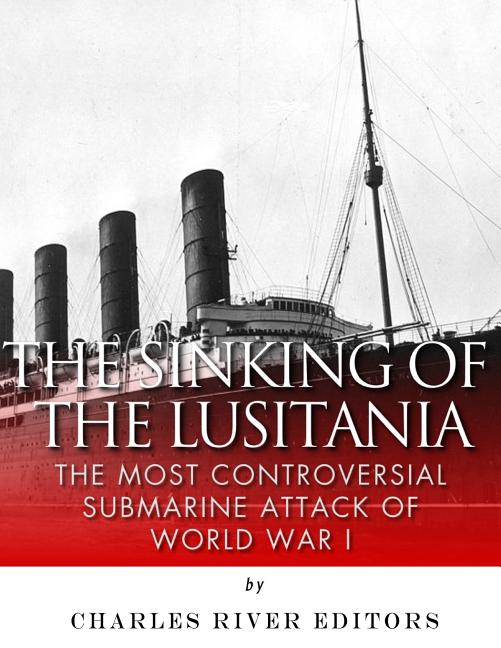
The Sinking of the Lusitania: The Most Controversial Submarine Attack of World War I (Paperback) by Charles River
Product details
| Management number | 240509760 | Release Date | 2026/07/16 | List Price | US$4.46 | Model Number | 240509760 | ||
|---|---|---|---|---|---|---|---|---|---|
| Category | |||||||||
9781985792449. New condition. Trade paperback. Language: English. Pages: 92. Trade paperback (US). Glued binding. 92 p. *Includes pictures <br> *Includes passengers' and crew members' accounts of the attack and sinking <br> *Discusses the debates over whether the Lusitania was smuggling weapons <br> *Includes a bibliography for further reading <br> <p> In 1906, the RMS Lusitania was at the forefront of transatlantic shipping. Briefly the largest ship in the world, the designers and engineers who built the Lusitania aimed for her to represent the height of luxury for passengers while also being the harbinger of a new technological age, replete with revolutionary engines that would allow the gigantic ship to move at speeds that would have been considered impossible just years earlier. Indeed, the highly competitive industry would spur the development of bigger and better ocean liners in the coming years, the most famous being the Titanic. </p><p> The Lusitania and the Titanic would become the two most famous ships of the early 20th century for tragic reasons, but the circumstances could not have been more different. While the Titanic is still notorious for being the world's best ocean liner at the time of its collision with an iceberg in 1912, the Lusitania's role as a popular ocean liner has been almost completely obscured by the nature of its sinking by a German U-boat in 1915. The Germans aimed to disrupt trade by the Allied forces, but they did not have the naval forces capable of seizing merchant ships and detaining them. Furthermore, the Germans rightly suspected that the British and Americans were using passenger liners and merchant ships to smuggle weaponry across the Atlantic, but since their sole edge in the Atlantic was their fleet of submarines, the Germans had no way of confirming their suspicions, short of sinking a ship and seeing if a detonation on board suggested the presence of munitions and gunpowder. </p><p> The Germans targeted many British merchant ships, but on May 7, 1915, a German U-boat controversially torpedoed the Lusitania, which sank less than 20 minutes after being struck. The attack killed over 1,000 people, including over 100 American civilians, infuriating the United States. After sinking the ship, the Germans immediately claimed that the boat was carrying "contraband of war" and was in a war zone, charges vehemently denied by the United States and the British. For awhile, the Germans tightened restrictions on their use of U-boats to placate the Americans and seek to keep them out of the war (though the restrictions would not last). </p><p> The sinking of the Lusitania in 1915 was the first major event that shifted public opinion in the United States, and support for joining the war began to rise across the country. Many Americans joined the "Preparedness Movement," which advocated at least preparing for war if not entering the war outright, and though the country would not declare war against Germany for two more years, the sinking of the Lusitania is still cited as a key event that set America on the path toward joining the war. </p><p> Given the importance of its sinking, debate over whether the Lusitania was carrying explosive munitions has raged on ever since. When the U-boat's torpedo hit the Lusitania and exploded, a second explosion followed the first explosion shortly after, and the Germans cited the second explosion as evidence that the torpedo had hit weapons munitions that ignited the second explosion, a charge that was strongly denied by the British. It would take multiple investigations, declassified documents, and even dives to the wreckage to determine whether the Lusitania was smuggling arms, and whether such munitions triggered the second explosion. </p><p> The Sinking of the Lusitania chronicles the construction and destruction of one of the most notorious ships of the 20th century. Along with pictures of important people, places, and events, you will learn about the sinking of the Lusitania like never before, in no time at all.</p>
The Sinking of the Lusitania (Paperback)| Book format | Paperback |
|---|---|
| Fiction/nonfiction | Non-Fiction |
| Genre | History |
| Publication date | February, 2018 |
| Pages | 92 |
| Subgenre | History |
| Publisher | Createspace Independent Publishing Platform |
| Original languages | English |
| Language | English |
| Binding type | Perfect Binding |
| Assembled product height | 0.19" |
| Assembled product weight | 0.52 lbs |
| Bisac subject heading | History |
Bestseller ranking
World War I Military History Books





Customers who viewed this product also viewed
Sterilite


Correction of product information
If you notice any omissions or errors in the product information on this page, please use the correction request form below.
Correction Request Form